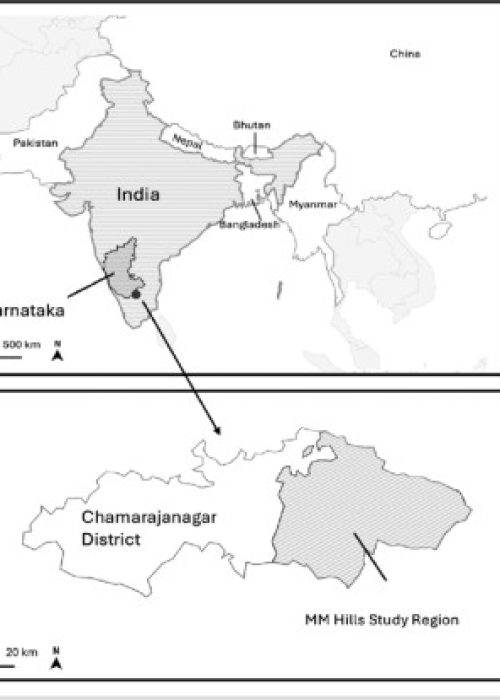
Making climate policies stable in local socio-ecological contexts is challenging. This paper examines whether locally legitimate institutions pursuing ‘climate-adjacent’ goals—whose environmental activities contribute to avoided emissions without explicitly framing their work as climate mitigation—can be leveraged as climate solutions. By emphasizing path dependencies within long-standing institutions, our research identifies how building on institutional stability rather than transformative solutions can offer policy entry points for climate action. Using mixed methods including 56 interviews analyzed through thematic coding and descriptive quantitative analysis, we study the MM Hills Lantana Craft Centre (LCC) in the Western Ghats-Eastern Ghats transition.