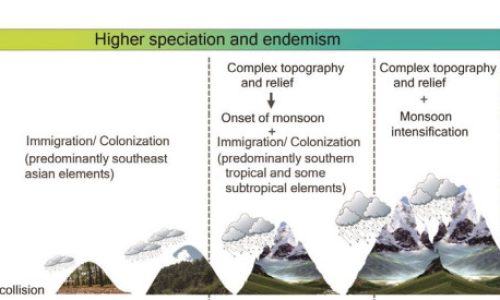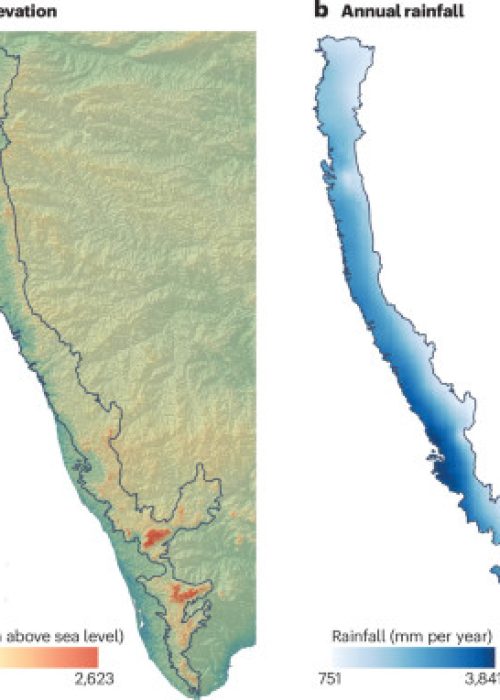
One of the world’s 36 global biodiversity hotspots, the Western Ghats region of India, harbours high species richness, endemism and biocultural diversity, while sustaining millions of people across peninsular India through critical ecosystem services. In this Review, we discuss the evolutionary origins, current distribution and threats to biodiversity in the Western Ghats, as well as conservation needs going forward. Complex geoclimatic history, biotic exchanges with Africa and Southeast Asia, the evolution of the monsoon system, rugged topography and human influences shape extant biodiversity patterns. Historical and contemporary land-use changes, dam construction, invasive species, linear infrastructure, and climate change have led to extensive habitat loss and fragmentation, degraded biodiversity, and eroded key ecosystem services. Securing the ecological future of the Western Ghats will require expanding and effectively managing protected areas, restoring ecosystems, and strengthening connectivity across fragmented habitats using both land-sparing and land-sharing approaches. These actions should be facilitated by remote sensing, DNA-based surveillance, artificial-intelligence-based biodiversity assessment and citizen science, alongside stronger policies, governance frameworks, and community-led stewardship. Ultimately, sustaining the biota of the Western Ghats demands recognizing this mountain chain as vital natural infrastructure, irreplaceable for biodiversity conservation, climate resilience, and the well-being of present and future generations.