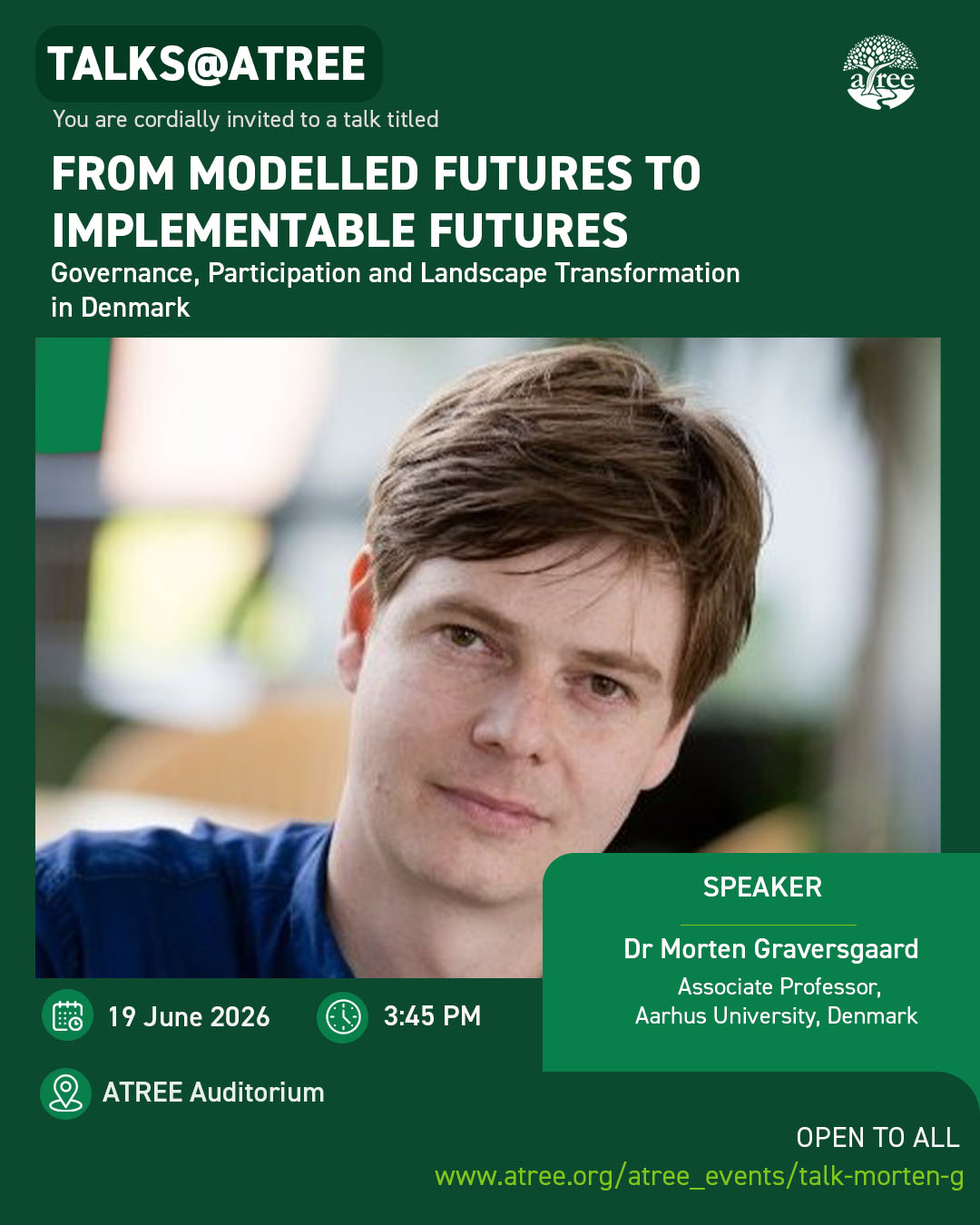
From Modelled Futures to Implementable Futures: Governance, Participation and Landscape Transformation in Denmark
Abstract
Many sustainability transitions are strong on targets, models and scenarios, but much weaker when it comes to implementation. In this talk, I use recent Danish land-use and nitrogen governance reforms as a live case of how national environmental goals are translated into local landscapes, stakeholder negotiations and farm-level decisions. Drawing on work from the Danish Green Tripartite policy agreement, Land-CRAFT, TRANSFORM and PlantPerform projects, I ask when modelled futures become legitimate, trusted and actionable. The talk will focus on the governance challenge of moving from spatial plans and decision-support tools to implementation capacity: landowner engagement, advisory systems, institutional trust, value chains and policy learning. I will also reflect on how these questions connect more broadly to social-ecological transitions, conservation practice and landscape governance in other contexts.
About the speaker
Morten Graversgaard is Associate Professor in Agroecology and Sustainable Resource Management at Aarhus University, Denmark. His research focuses on collaborative governance, agricultural and landscape transitions, nitrogen and water governance, stakeholder participation and the implementation of environmental policy. He works across several Danish and European research projects on land-use change, decision-support tools, advisory systems, nature-based solutions and agricultural sustainability. A central part of his current work examines the Danish Green Tripartite Agreement as a large-scale governance experiment in translating national climate, water, biodiversity and land-use goals into local plans and practical implementation. He is also involved in international work on nitrogen governance and science–policy–practice